
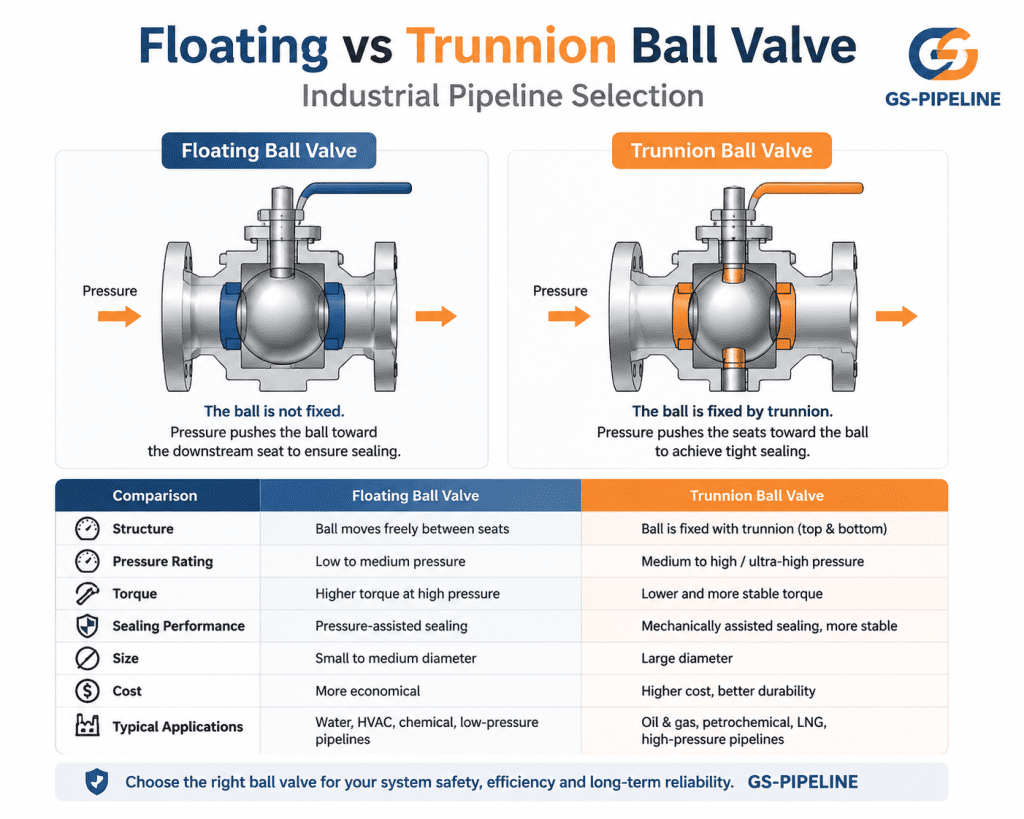
Floating vs Trunnion Ball Valve: Industrial Pipeline Selection
Introduction
In industrial pipeline systems, ball valves are one of the most widely used shut-off valves due to their excellent sealing performance, fast operation, and durability. However, selecting the correct type is critical for system safety and efficiency—especially in oil & gas, petrochemical, water treatment, and high-pressure transmission systems.
The two main structural types are floating ball valves and trunnion mounted ball valves. While both serve the same basic function—isolating or controlling flow—their internal design, pressure handling capability, and application range are significantly different.
Understanding these differences helps engineers and procurement teams choose the right solution from a reliable pipeline valve supplier such as Shaanxi Gold-Stone I/E Co., Ltd..
What Is a Floating Ball Valve?
A floating ball valve is designed so that the ball is not fixed in position. Instead, it is “floating” between two valve seats. When pressure is applied, the ball is pushed downstream, pressing tightly against the seat to create a seal.
Key Features:
- Simple structure and compact design
- Bi-directional sealing capability
- Lower manufacturing cost
- Tight sealing under low to medium pressure
Working Principle:
The fluid pressure pushes the ball toward the downstream seat. This pressure-assisted sealing improves tightness but also increases friction between the ball and seat at higher pressures.
Limitations:
- Not suitable for very high pressure or large diameter pipelines
- Higher operating torque under high pressure
- Seat wear may increase in severe service conditions
What Is a Trunnion Ball Valve?
A trunnion mounted ball valve uses a fixed ball supported by a trunnion (upper and lower shaft). The ball does not float; instead, it rotates in place while the seats move toward the ball under pressure.
Key Features:
- Suitable for high-pressure and large-diameter pipelines
- Lower operating torque compared to floating design
- Stable sealing performance under extreme conditions
- Often designed according to API 6D standards
Working Principle:
The ball is mechanically anchored. Line pressure pushes the seats against the ball, ensuring a consistent seal without excessive friction.
Advantages:
- Excellent performance in high-pressure systems
- Reduced wear and longer service life
- Suitable for automated actuators
- Ideal for critical pipeline systems (oil, gas, LNG)
Floating vs Trunnion Ball Valve: Key Differences
1. Structure Design
- Floating Ball Valve: Ball moves freely between seats
- Trunnion Ball Valve: Ball is fixed and supported by trunnion system
2. Pressure Handling
- Floating: Low to medium pressure applications
- Trunnion: Medium to ultra-high pressure systems
3. Torque Requirement
- Floating: Higher torque at high pressure
- Trunnion: Lower and stable torque
4. Sealing Performance
- Floating: Depends on line pressure
- Trunnion: Mechanically assisted sealing for stability
5. Size and Application
- Floating: Small to medium pipelines
- Trunnion: Large diameter and high-pressure pipelines
6. Cost
- Floating: More economical
- Trunnion: Higher cost but better durability and safety
Application Scenarios
Floating Ball Valve Applications
- Water distribution systems
- Low-pressure industrial pipelines
- Chemical dosing systems
- HVAC and utility piping
Trunnion Ball Valve Applications
- Oil and gas transmission pipelines
- Refinery processing systems
- LNG and cryogenic pipelines
- High-pressure petrochemical plants
- Long-distance pipeline networks
How to Choose the Right Ball Valve
Selecting between floating and trunnion designs depends on several engineering factors:
1. Pressure Rating
If system pressure exceeds medium levels (especially above 900 PSI), trunnion design is strongly recommended.
2. Pipeline Diameter
Large diameter pipelines typically require trunnion ball valves to maintain sealing stability.
3. Operating Frequency
For frequent operation or automation, trunnion valves offer smoother torque performance.
4. Safety Requirements
Critical systems (oil, gas, LNG) prioritize trunnion designs due to better reliability.
Importance of Choosing the Right Pipeline Valve Supplier
A high-quality valve is not only about design—it depends heavily on manufacturing precision, material selection, and testing standards.
A professional pipeline valve supplier should provide:
- API 6D / API 598 compliant valves
- Pressure testing and quality inspection
- Material traceability (carbon steel, stainless steel, alloy steel)
- Custom size and pressure class options
- Engineering support for project selection
Suppliers like Shaanxi Gold-Stone I/E Co., Ltd. provide full-range pipeline solutions including ball valves, gate valves, flanges, and pipe fittings for global industrial projects.
Conclusion
The difference between floating and trunnion ball valves is mainly determined by structure, pressure capability, and application environment.
- Floating ball valves are ideal for cost-effective, low-to-medium pressure systems.
- Trunnion ball valves are designed for high-pressure, large-diameter, and critical pipeline applications.
Choosing the right type ensures safety, reduces maintenance cost, and improves long-term system performance. For industrial projects, working with a reliable pipeline valve supplier is essential to guarantee quality and operational stability.