
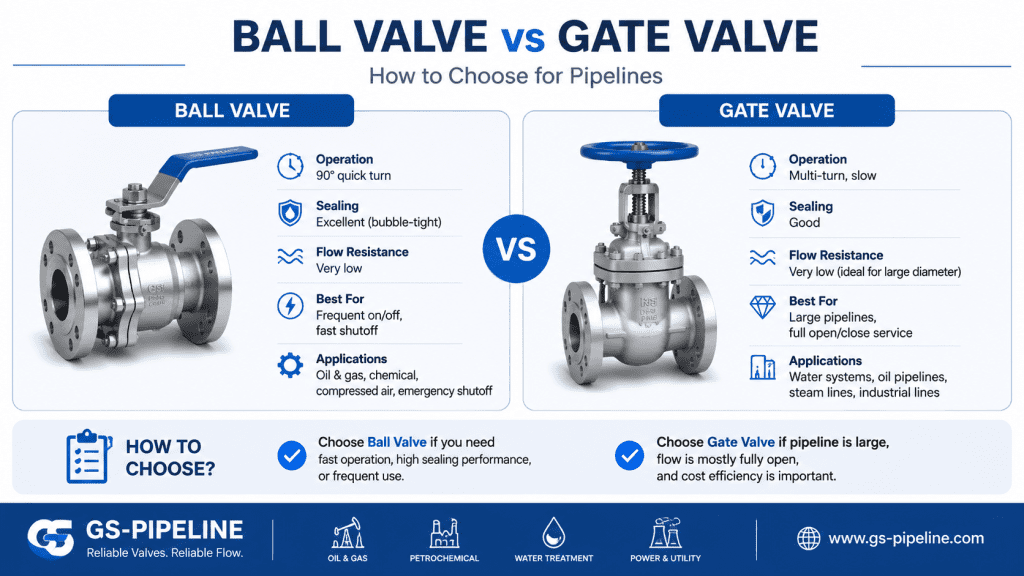
Ball Valve vs Gate Valve: How to Choose for Pipelines
Introduction
In industrial pipeline systems, selecting the right valve type directly affects flow efficiency, safety, maintenance cost, and system reliability. Two of the most commonly used isolation valves are ball valves and gate valves. Although both are widely used in oil & gas, petrochemical, water treatment, and general industrial pipelines, they serve different operating principles and performance requirements.
This guide compares ball valve vs gate valve in terms of structure, pressure performance, flow control, installation, and applications to help engineers and buyers make the right selection.
1. What Is a Ball Valve?
A ball valve uses a rotating spherical ball with a hole (bore) through the center. When the handle turns 90 degrees, the bore aligns or blocks the flow.
Key Features:
- Quick quarter-turn operation (90°)
- Excellent tight sealing performance
- Low pressure drop
- Suitable for frequent on/off control
Advantages:
- Fast opening and closing
- High sealing capability (bubble-tight shutoff)
- Compact structure
- Low torque operation
Limitations:
- Not ideal for throttling (partial opening may damage seat)
- Higher cost compared to gate valves in large sizes
Typical Applications:
- Oil & gas pipelines
- Chemical processing systems
- Water supply shutoff systems
- Compressed air and utility lines
2. What Is a Gate Valve?
A gate valve uses a flat or wedge-shaped gate that moves vertically to block or allow flow. It is designed mainly for full open or full close operation.
Key Features:
- Multi-turn operation (slow opening/closing)
- Designed for full flow or full shutoff
- Minimal flow resistance when fully open
Advantages:
- Very low pressure loss when fully open
- Suitable for large diameter pipelines
- Cost-effective for industrial systems
Limitations:
- Slow operation
- Poor throttling performance
- Seat and gate wear if used partially open
Typical Applications:
- Water distribution networks
- Oil pipeline main lines
- Steam systems
- Industrial process isolation
3. Ball Valve vs Gate Valve: Key Comparison
3.1 Flow Control Performance
- Ball Valve: Best for fast on/off control
- Gate Valve: Best for full open flow with minimal resistance
�� Ball valves are preferred when frequent operation is required.
3.2 Pressure Drop and Flow Efficiency
- Ball Valve: Very low pressure drop when fully open
- Gate Valve: Also low pressure drop, but slightly better in very large pipelines
�� Both are suitable for high-flow systems, but gate valves dominate in large-diameter main lines.
3.3 Sealing Performance
- Ball Valve: Excellent sealing, bubble-tight closure
- Gate Valve: Good sealing but may experience leakage over time due to wear
�� Ball valves are better for critical shutoff applications.
3.4 Operation Speed
- Ball Valve: 90° quick operation
- Gate Valve: Multi-turn slow operation
�� Ball valves are ideal for emergency shutoff systems.
3.5 Maintenance and Durability
- Ball Valve: Easier maintenance, but seat wear if misused for throttling
- Gate Valve: More tolerant for full open service but requires more maintenance in harsh conditions
3.6 Cost Consideration
- Ball Valve: Higher cost in large sizes
- Gate Valve: More economical for large industrial pipelines
4. Selection Guide: How to Choose the Right Valve
Choose Ball Valve if:
- You need fast shutoff (emergency isolation)
- System requires frequent operation
- High sealing performance is critical
- Space is limited
Choose Gate Valve if:
- Pipeline is large diameter
- Valve is mainly used in full open/close mode
- Cost optimization is important
- Flow is continuous and rarely interrupted
5. Industrial Applications Overview
Oil & Gas Industry
- Ball valves: wellhead control, emergency shutoff systems
- Gate valves: main transmission pipelines
Petrochemical Industry
- Ball valves: chemical injection systems
- Gate valves: refinery process pipelines
Water Treatment Systems
- Ball valves: pump stations, control units
- Gate valves: distribution networks
Power Plants
- Ball valves: auxiliary systems
- Gate valves: steam and cooling water lines
6. Technical Summary Table
| Feature | Ball Valve | Gate Valve |
| Operation | Quarter-turn | Multi-turn |
| Sealing | Excellent | Good |
| Flow Control | On/Off only | On/Off only |
| Pressure Drop | Very low | Very low |
| Speed | Fast | Slow |
| Cost | Medium–High | Low–Medium |
| Best Use | Frequent switching | Large pipeline isolation |
7. Industry Insight
From a global engineering procurement perspective, search demand for industrial valves is strongly driven by:
- Oil & gas infrastructure expansion
- Water treatment modernization
- Petrochemical plant upgrades
- Industrial automation systems
Search intent for keywords like “ball valve vs gate valve” typically indicates users are in the decision stage of procurement.
- Provide clear comparison tables
- Include application-based selection logic
- Target engineering and procurement keywords
- Focus on real industrial scenarios
Conclusion
Both ball valves and gate valves are essential components in industrial pipeline systems, but they serve different engineering purposes. A ball valve is best for fast, reliable shutoff with superior sealing, while a gate valve is ideal for large-scale pipelines requiring minimal flow resistance and cost efficiency.
For optimal system performance, engineers should evaluate pressure conditions, flow frequency, installation space, and maintenance requirements before selecting the appropriate valve type.