
Introduction
In industrial piping systems, selecting the right connection type is critical for safety, efficiency, and long-term performance. Among the most widely used options are the flanged valve and the threaded valve.
Both are essential categories of industrial valves, but they serve different pressure ranges, pipe sizes, and installation environments. Understanding their differences helps engineers, contractors, and procurement teams reduce leakage risk, improve maintenance efficiency, and optimize total system cost.
As a professional pipeline supplier, GS-PIPELINE provides a full range of industrial valves designed for oil & gas, petrochemical, water treatment, and construction applications.
What is a Flanged Valve?
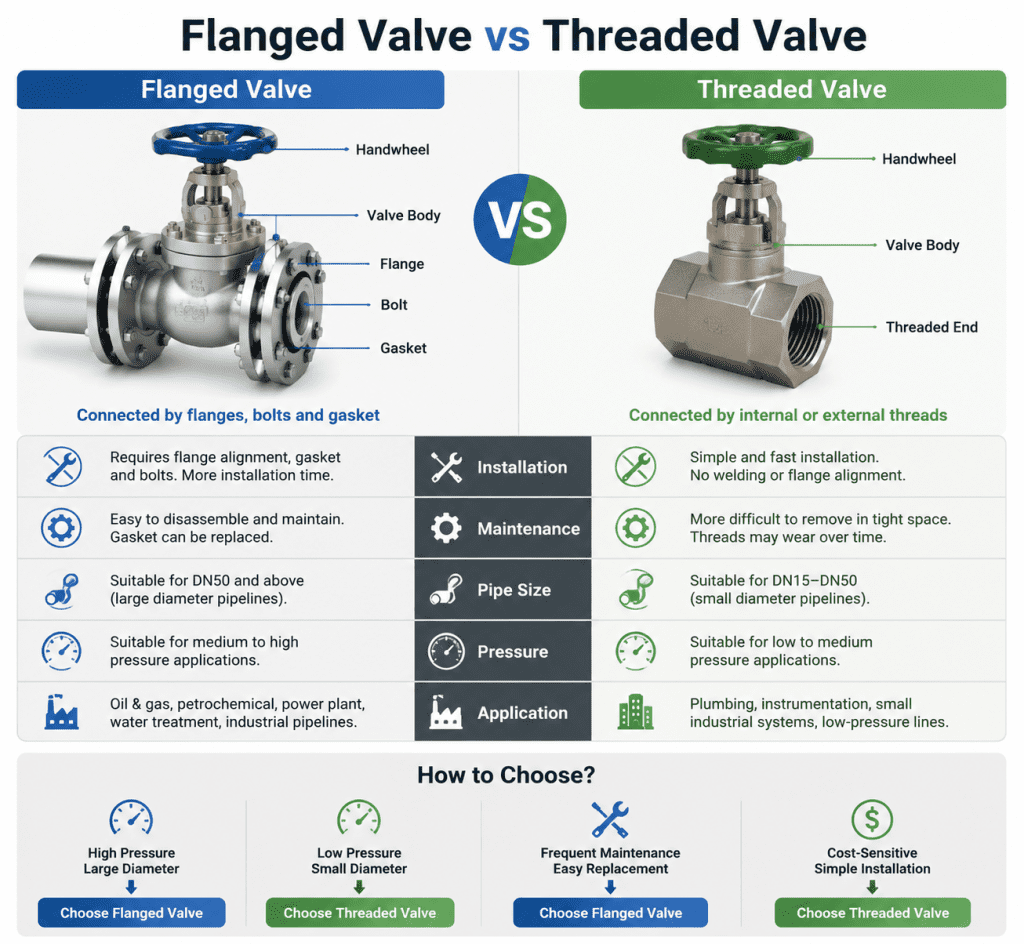
A flanged valve is a valve connected to the pipeline using flanges, bolts, and gaskets. It is one of the most common connection types in medium to large industrial piping systems.
Key Features:
- Strong sealing performance under high pressure
- Suitable for frequent maintenance and disassembly
- Ideal for medium to large pipe diameters (generally DN50 and above)
- Compatible with ASME, API, and DIN flange standards
Typical Applications:
- Oil & gas pipelines
- Petrochemical plants
- Power stations
- Water treatment systems
What is a Threaded Valve?
A threaded valve is connected to pipes using internal or external threads (commonly NPT or BSP). It is widely used in small-diameter piping systems.
Key Features:
- Simple installation without welding or flange bolts
- Cost-effective for small systems
- Best suited for low to medium pressure applications
- Easy replacement in compact piping layouts
Typical Applications:
- Residential and commercial plumbing
- Instrumentation pipelines
- Small industrial auxiliary systems
- Low-pressure fluid control systems
Installation Comparison: Flanged Valve vs Threaded Valve
1. Flanged Valve Installation
Flanged valve installation requires:
- Aligning pipe flanges accurately
- Installing gasket between flange faces
- Tightening bolts in a cross pattern
Advantages in Installation:
- High alignment accuracy ensures sealing reliability
- Suitable for large pipelines with heavy flow media
- Easy to remove and reinstall during maintenance
Limitations:
- Requires more space and tools
- Higher installation time and labor cost
2. Threaded Valve Installation
Threaded valve installation requires:
- Pipe thread machining or pre-threaded pipes
- Sealing with PTFE tape or sealing compound
- Manual tightening into pipeline connection
Advantages in Installation:
- Fast and simple assembly
- No need for welding or flange alignment
- Lower initial installation cost
Limitations:
- Not ideal for large diameter pipelines
- Higher risk of leakage under vibration or thermal expansion
Maintenance Comparison
Flanged Valve Maintenance
Flanged valves are designed for industrial-grade maintainability:
- Easy dismantling without damaging the pipeline
- Gasket replacement ensures long-term sealing reliability
- Suitable for frequent inspection systems
�� Best choice for critical systems requiring regular maintenance.
Threaded Valve Maintenance
Threaded valves are more compact but less flexible:
- Difficult to remove in tight installations
- Threads may wear after repeated disassembly
- Sealant must be reapplied during reinstallation
�� Best for small systems with low maintenance frequency.
Pipe Size & Application Scenarios
| Valve Type | Recommended Pipe Size | Pressure Level | Best Use Case |
| Flanged Valve | DN50 and above | Medium to High | Industrial pipelines |
| Threaded Valve | DN15–DN50 | Low to Medium | Small systems & instruments |
Flanged Valve vs Threaded Valve: Key Differences
Flanged Valve Advantages:
- High strength and durability
- Excellent sealing performance
- Suitable for high-pressure systems
- Easy maintenance and replacement
Threaded Valve Advantages:
- Compact structure
- Low installation cost
- Simple assembly process
- Ideal for limited-space systems
Industry Selection Guide
Choosing between flanged and threaded valves depends on:
1. Pressure Requirements
- High pressure → Flanged valve
- Low pressure → Threaded valve
2. Pipe Diameter
- Large pipelines → Flanged valve
- Small pipelines → Threaded valve
3. Maintenance Frequency
- Frequent maintenance → Flanged valve
- Rare maintenance → Threaded valve
4. Installation Environment
- Industrial plants → Flanged valve
- Compact systems → Threaded valve
Why Choose GS-PIPELINE?
As a professional supplier of pipeline systems, GS-PIPELINE provides:
- Full range of industrial valves (ball valve, gate valve, check valve)
- ASME/API standard compliance
- High-quality flanged and threaded connection solutions
- Export experience for global oil & gas projects
- Customized solutions for pipeline engineering projects
With strong manufacturing and export capabilities, GS-PIPELINE supports industries including:
- Oil & Gas
- Petrochemical
- LNG systems
- Water treatment
- Construction engineering
Conclusion
Both flanged valves and threaded valves play important roles in modern pipeline systems.
- Choose flanged valves for high-pressure, large-diameter, and industrial-grade applications requiring frequent maintenance.
- Choose threaded valves for small-scale, low-pressure, and cost-sensitive systems.
Selecting the correct valve type improves system safety, reduces leakage risk, and extends pipeline service life.
For reliable industrial valve solutions, GS-PIPELINE provides a complete product range tailored to global engineering standards.