
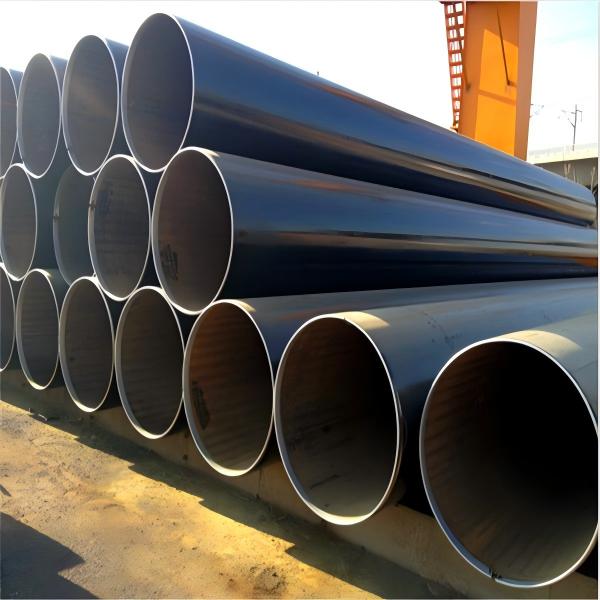
Quick Summary: ERW vs LSAW vs SSAW at a Glance
For procurement managers and pipeline engineers, choosing the right pipe often depends on three main variables: diameter requirements, operating pressure, and project budget.
Comparison Table
| Pipe Type | Manufacturing Method | Typical Diameter Range | Primary Application |
|---|---|---|---|
| ERW (Electric Resistance Welded) | Steel strip rolled longitudinally; high-frequency electric current welding | Small to Medium (Up to 24 inches) | Medium/low-pressure water, gas, and general industrial fluids |
| LSAW (Longitudinal Submerged Arc Welded) | Heavy steel plate formed via JCOE/UOE; straight-seam submerged arc welding | Large (16 to 60+ inches) | High-pressure oil & gas transmission, offshore, and refinery systems |
| SSAW (Spiral Submerged Arc Welded) | Steel coil formed helically; spiral-seam submerged arc welding | Large to Extra-Large (Up to 100+ inches) | Long-distance water mains, low-pressure gas, piling, and structural use |
Manufacturing Comparison
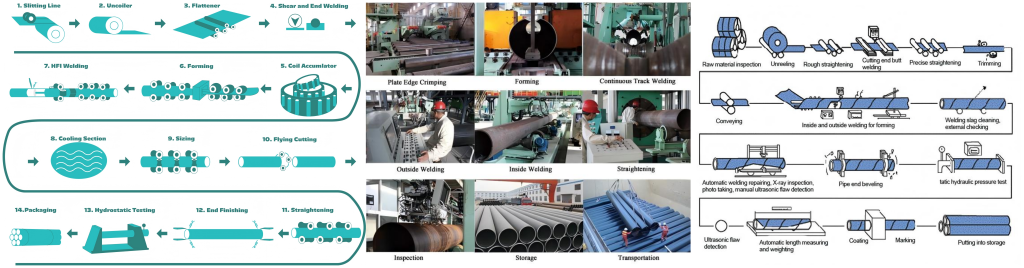
1. ERW Pipe: High Cost-Efficiency for Medium & Low Pressure
Manufacturing Process
ERW (Electric Resistance Welded) pipes are manufactured by cold-forming a continuous steel strip into a cylindrical shape. Instead of using a filler metal, the edges are heated using high-frequency electrical resistance and squeezed together to create a solid, longitudinal weld seam.
Key Advantages
- Cost-Effective Production: The continuous rolling process allows for high-speed, high-volume production with lower manufacturing costs.
- High Dimensional Accuracy: ERW pipes offer uniform wall thickness, tight geometric tolerances, and excellent concentricity.
- Clean Geometry: Because no filler material is added during the welding process, the surface remains smooth.
Best Applications
ERW pipes are highly efficient for medium and low-pressure distribution systems. They are widely specified for city gas piping networks, water supply distribution, structural columns, and general mechanical applications.
ERW Pipe Example
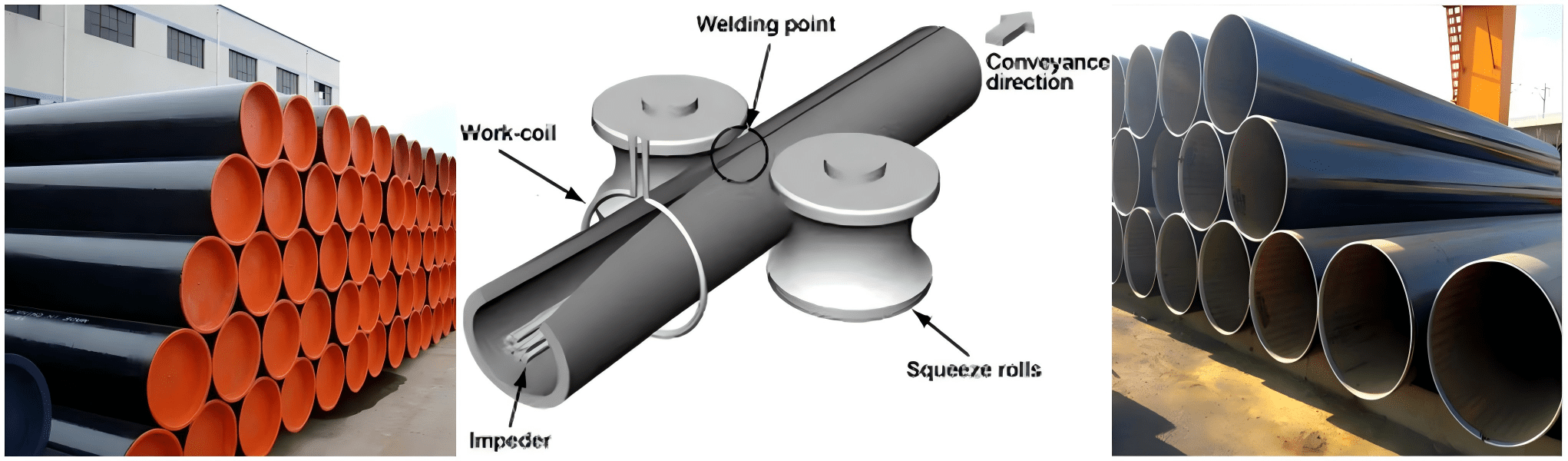
2. LSAW Pipe: The Gold Standard for High-Pressure Energy Pipelines
Manufacturing Process
LSAW (Longitudinal Submerged Arc Welded) pipes are produced using heavy steel plates as raw materials. The plate is molded into a cylinder through specialized forming processes (such as JCOE or UOE) and then welded longitudinally using a double-sided submerged arc process.
After welding, the pipe undergoes mechanical expansion to optimize structural roundness and relieve internal stress.
Key Advantages
- Extreme Heavy-Wall Capacity: LSAW processing allows for very thick walls, enabling pipes to withstand massive internal pressures.
- Superior Mechanical Integrity: The longitudinal weld seam undergoes stringent non-destructive testing (NDT), offering low residual stress and high fracture toughness.
- High Reliability under Stress: Excellent resistance to fatigue, making them resilient in harsh environments.
Best Applications
LSAW is the preferred choice for large-diameter, high-pressure oil and gas trunklines, long-distance subsea transmission lines, LNG plant piping, and critical refinery systems.
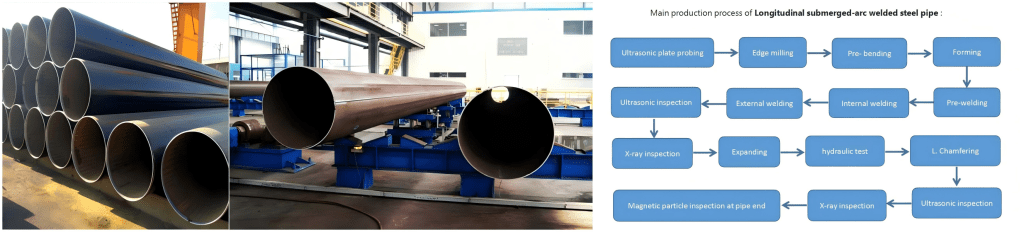
3. SSAW Pipe: The Flexible Choice for Large Diameter Infrastructure
Manufacturing Process
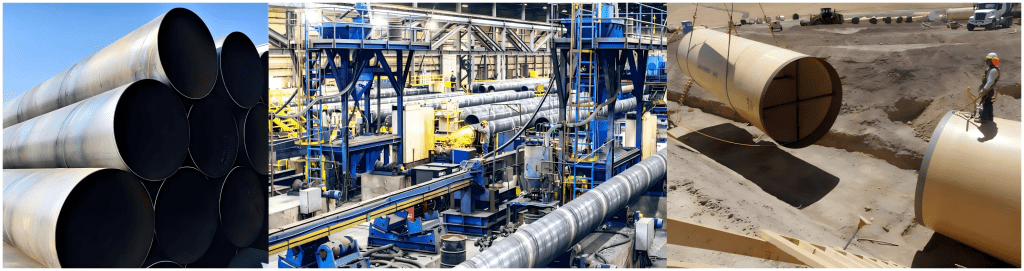
SSAW (Spiral Submerged Arc Welded) pipes, also known as HSAW pipes, are made by feeding a hot-rolled steel strip through a forming machine at a specific welding angle (helix angle).
This allows a relatively narrow steel coil to be formed into a much larger diameter cylinder, which is then welded along a continuous spiral seam using double-sided submerged arc technology.
Key Advantages
- Diameter Versatility: A single width of steel coil can be used to manufacture SSAW pipes of various diameters simply by adjusting the forming angle.
- Continuous Long Lengths: SSAW manufacturing supports continuous production, meaning extremely long single-pipe sections can be fabricated without circumferential joint welds.
- Stress Distribution: The spiral seam layout helps distribute stress more evenly across the pipe body when subjected to bending forces.
Best Applications
SSAW pipes are highly efficient for large-diameter municipal water mains, long-distance low-to-medium pressure liquid pipelines, structural piling, and civil engineering drainage systems.
💡 Technical FAQ for Pipeline Engineering
Q: Can SSAW pipes replace LSAW pipes in high-pressure oil and gas trunklines?
A: Generally, no.
While SSAW is highly cost-effective for large diameters, its weld seam is roughly 30% to 100% longer than an LSAW straight seam.
In critical high-pressure oil and gas transmission, international standards such as API 5L prioritize LSAW because its straight seam minimizes potential defect surface areas and exhibits lower risk of stress corrosion cracking under extreme pressures.
Premium Welded Steel Pipe Solutions from Shaanxi Gold-Stone
Selecting the ideal pipe specification requires balancing structural demands, environmental factors, and budget constraints.
As a reliable global steel pipe supplier, Shaanxi Gold-Stone I/E Co., Ltd. offers a complete portfolio of high-grade ERW, LSAW, and SSAW pipes customized to your project requirements:
Material Grades
- Available in premium Carbon Steel
- Stainless Steel
- Specialized Alloy Steel
Compliance Standards
- Fully certified to API 5L (Grades B through X80)
- ASME / ASTM
- DIN / EN requirements
Global Project Delivery
Engineered for:
- Heavy industrial pipelines
- Petrochemical plants
- LNG terminals
- Power generation facilities worldwide
Our technical engineering team provides comprehensive material support, testing certification, and logistics management to streamline your pipeline infrastructure procurement.
Conclusion
Each welded pipe type serves a distinct engineering purpose:
- ERW delivers the best balance of precision and cost for medium and low-pressure applications.
- LSAW provides maximum strength and reliability for critical high-pressure energy infrastructure.
- SSAW offers exceptional diameter flexibility and economic advantages for large-scale water and structural projects.
By understanding the manufacturing characteristics and application strengths of each option, project engineers can optimize both performance and lifecycle costs when selecting industrial pipeline systems.