
Seamless Steel Pipe vs Welded Steel Pipe: Which One Should You Choose?
Selecting the right steel pipe is one of the most important decisions in any pipeline project. The two most common options are seamless steel pipe and welded steel pipe. While they may appear similar, their manufacturing methods, performance characteristics, and costs differ significantly.
Understanding these differences helps engineers, contractors, and procurement teams choose the most suitable solution for their operating conditions and budget.
Seamless Steel Pipe
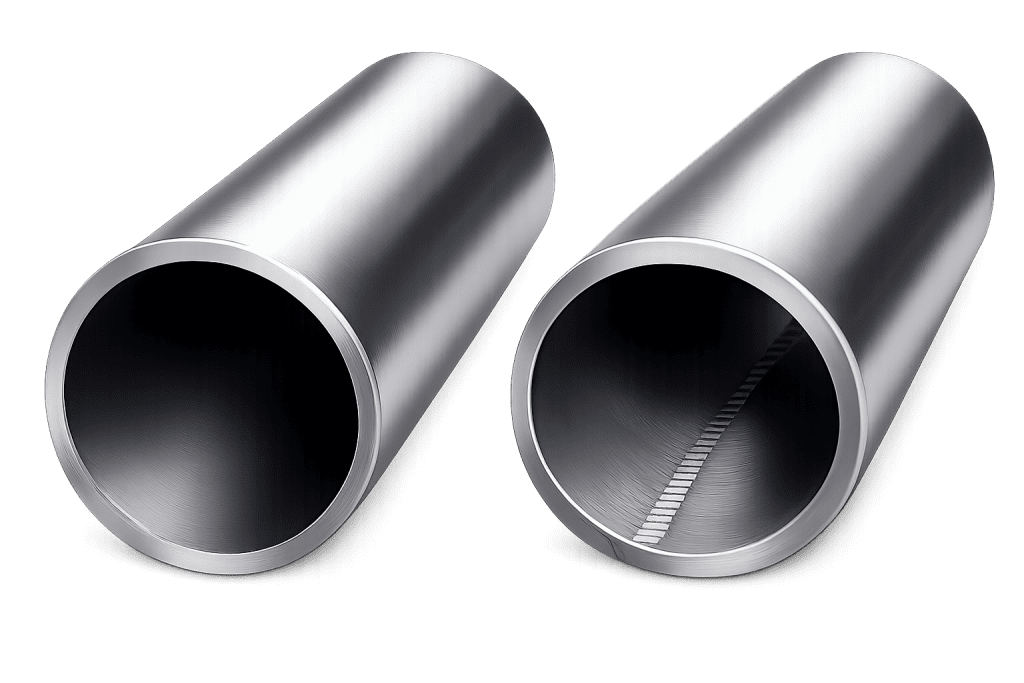
Seamless steel pipe is manufactured from a solid steel billet. The billet is heated and pierced to form a hollow tube without any welded joint.
Advantages
- No weld seam, resulting in uniform strength throughout the pipe.
- Excellent resistance to high pressure and high temperature.
- Reduced risk of seam-related corrosion or failure.
- Ideal for critical industrial applications.
Limitations
- Higher manufacturing cost.
- Longer production lead times.
- Wall thickness may vary slightly compared to welded pipe.
Typical Applications
- Oil and gas production
- Petrochemical plants
- Power generation
- High-pressure boilers
- Hydraulic systems
Welded Steel Pipe
Welded steel pipe is produced by rolling steel plate or strip into a cylindrical shape and joining the edges through welding processes such as ERW (Electric Resistance Welding) or SAW (Submerged Arc Welding).
Advantages
- Lower production cost.
- Excellent dimensional accuracy.
- Uniform wall thickness.
- Available in large diameters and long lengths.
- Faster delivery times.
Limitations
- Contains a welded seam.
- Generally lower pressure capacity than seamless pipe.
- Not preferred for the most critical high-pressure applications.
Typical Applications
- Water transmission pipelines
- Structural construction
- HVAC systems
- Low-pressure gas distribution
- Industrial process piping
Pressure Performance Comparison
The operating pressure of a piping system is often the deciding factor when selecting between seamless and welded pipe.
Seamless Pipe
Suitable for:
- High-pressure service
- High-temperature environments
- Critical process systems
Typical pressure range:
- Above 1,000 PSI
- Can exceed 10,000 PSI depending on material grade, wall thickness, and pipe size
Welded Pipe
Suitable for:
- Low-to-medium pressure systems
- General industrial applications
- Cost-sensitive projects
Typical pressure range:
- Below 1,000 PSI in many common applications
- Actual pressure capability depends on design specifications and standards
API 5L Pipe Standards
For oil and gas transportation systems, API 5L is one of the most widely used pipeline standards.
API 5L PSL1
- Standard quality requirements
- Commonly used for conventional pipeline transportation
- Available in both seamless and welded forms
API 5L PSL2
- Stricter chemical composition requirements
- Enhanced mechanical properties
- More rigorous testing and inspection
- Frequently selected for demanding offshore and high-pressure applications
Seamless vs Welded Steel Pipe Comparison
| Feature | Seamless Steel Pipe | Welded Steel Pipe |
| Manufacturing | Formed from solid billet | Rolled and welded from steel plate |
| Weld Seam | None | Present |
| Cost | Higher | Lower |
| Strength | Excellent | Very good |
| Pressure Capacity | High | Medium |
| Wall Thickness Uniformity | Good | Excellent |
| Delivery Time | Longer | Shorter |
| Large Diameter Availability | Limited | Excellent |
| Typical Standards | API 5L PSL2, ASTM A106 | API 5L PSL1, ASTM A53 |
Which Pipe Should You Choose?
Choose Seamless Steel Pipe When:
- Operating pressure is high.
- Service temperature is extreme.
- The medium is hazardous or corrosive.
- Maximum reliability is required.
- Failure could cause significant safety or environmental risks.
Choose Welded Steel Pipe When:
- Budget is a major consideration.
- The system operates at low or medium pressure.
- Large-diameter pipelines are required.
- Fast production and delivery are important.
- Dimensional consistency is a priority.
Conclusion
Both seamless and welded steel pipes have important roles in modern industrial piping systems. Seamless pipe provides superior performance in high-pressure and critical applications, while welded pipe offers a cost-effective solution for general-purpose and large-scale projects.
The best choice depends on operating pressure, temperature, project budget, safety requirements, and applicable industry standards. Evaluating these factors carefully will ensure long-term performance and reliability for your pipeline system.