
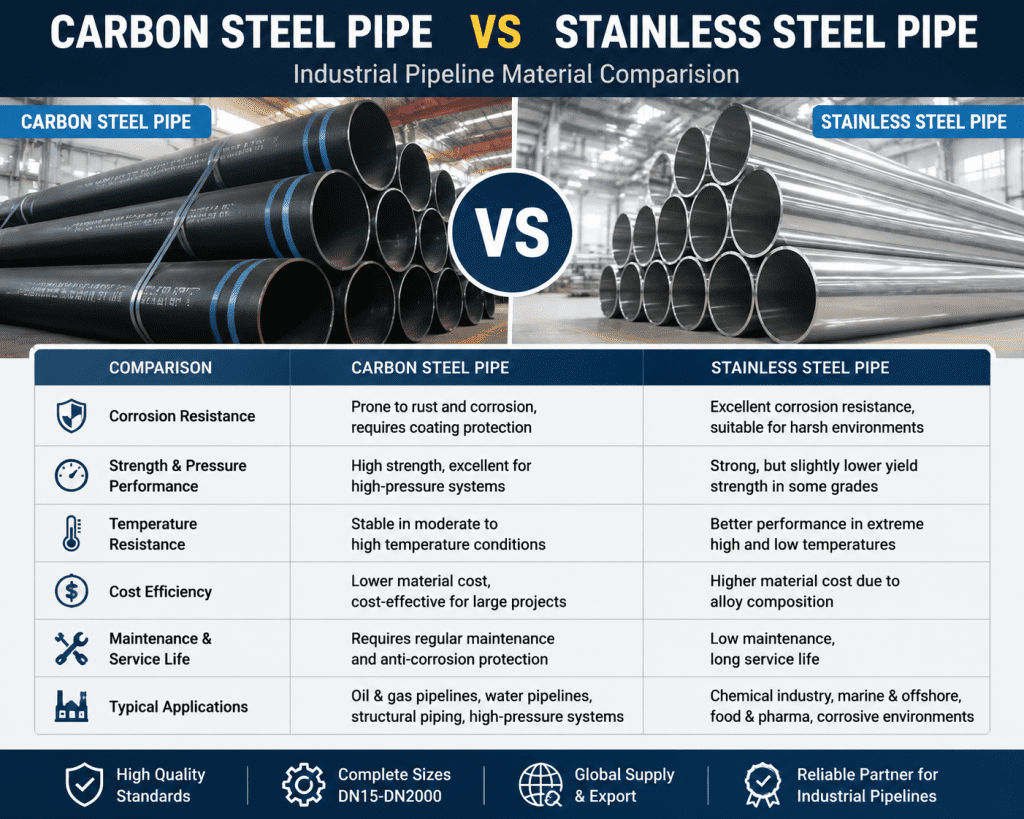
Carbon Steel vs Stainless Steel Pipe: Industrial Pipeline Material Comparison
Introduction: Choosing the Right Material for Industrial Pipelines
In modern industrial pipeline systems, selecting the correct material is critical for safety, performance, and long-term cost efficiency. Among the most widely used materials are carbon steel pipe and stainless steel pipe, both essential in oil & gas, petrochemical, construction, and water transmission projects.
At Shaanxi Gold-Stone I/E Co., Ltd., we supply a full range of industrial steel pipes, including API 5L carbon steel pipes and stainless steel piping systems for global industrial applications.
This guide provides a professional comparison of carbon steel vs stainless steel pipe to help engineers and procurement teams choose the right solution.
1. Carbon Steel Pipe Overview
Carbon steel pipe is one of the most commonly used materials in industrial pipeline engineering. It is primarily composed of iron and carbon, offering high strength and excellent pressure-bearing capacity.
Key Features:
- High tensile strength
- Excellent pressure resistance
- Cost-effective for large-scale projects
- Requires anti-corrosion protection (coating, painting, galvanizing)
Common Standards:
- API 5L
- ASTM A106
- ASTM A53
Industrial Applications:
- Oil & gas transmission pipelines
- Water supply and distribution systems
- Structural steel piping systems
- High-pressure industrial pipelines
�� Carbon steel pipe is widely used in long-distance pipeline infrastructure due to its strength and cost efficiency.
2. Stainless Steel Pipe Overview
Stainless steel pipe is an alloy steel containing chromium (≥10.5%), which forms a protective oxide layer that prevents corrosion.
Key Features:
- Excellent corrosion resistance
- Suitable for aggressive chemical environments
- High temperature stability
- Long service life with low maintenance
Common Grades:
- 304 / 304L stainless steel pipe
- 316 / 316L stainless steel pipe
- Duplex stainless steel (2205, 2507)
Industrial Applications:
- Chemical processing systems
- Marine and offshore pipelines
- Food & pharmaceutical industries
- High-corrosion environments
�� Stainless steel pipe is preferred where corrosion resistance is more important than cost.
3. Carbon Steel vs Stainless Steel Pipe Comparison
3.1 Corrosion Resistance
- Carbon steel pipe:
Prone to rust and corrosion without protective coatings. - Stainless steel pipe:
Naturally corrosion-resistant due to chromium oxide layer.
✔ Winner: Stainless steel pipe
3.2 Strength and Pressure Performance
- Carbon steel pipe:
Excellent strength, widely used in high-pressure pipeline systems. - Stainless steel pipe:
Strong but slightly lower yield strength in some grades.
✔ Winner: Carbon steel pipe (for high-pressure systems)
3.3 Temperature Resistance
- Carbon steel pipe:
Stable in moderate to high temperature industrial conditions. - Stainless steel pipe:
Performs better in extreme temperature variations.
✔ Winner: Stainless steel pipe
3.4 Cost Efficiency
- Carbon steel pipe:
Low cost, ideal for large-scale pipeline projects. - Stainless steel pipe:
Higher material cost due to alloy composition.
✔ Winner: Carbon steel pipe
3.5 Maintenance and Service Life
- Carbon steel pipe:
Requires coatings and regular maintenance. - Stainless steel pipe:
Low maintenance and long lifecycle.
✔ Winner: Stainless steel pipe
4. Industrial Application Guide (How to Choose)
Choose Carbon Steel Pipe for:
- Oil & gas transmission pipelines
- High-pressure industrial systems
- Cost-sensitive infrastructure projects
- Large diameter pipeline systems (DN50–DN2000)
Choose Stainless Steel Pipe for:
- Chemical and corrosive media systems
- Offshore and marine environments
- Food-grade and sanitary applications
- High durability requirements
5. Engineering Insight: Hybrid Pipeline Design
In many modern industrial pipeline systems, engineers use a hybrid material strategy:
- Carbon steel pipes for main transmission lines
- Stainless steel pipes for critical corrosion zones
This approach optimizes both cost efficiency and system reliability.
6. Why Choose gs-pipeline.com?
At Shaanxi Gold-Stone I/E Co., Ltd., we specialize in:
- Carbon steel pipe (API 5L, ASTM A106, ASTM A53)
- Stainless steel pipe (304, 316, duplex grades)
- Pipe fittings, flanges, valves, and complete pipeline systems
- Global supply for oil & gas, construction, and industrial projects
We provide factory-direct pricing, strict quality control, and global export support.
Conclusion
The choice between carbon steel pipe vs stainless steel pipe depends on project requirements:
- Carbon steel = strength + cost efficiency
- Stainless steel = corrosion resistance + durability
Understanding these differences ensures safer, more efficient industrial pipeline system design.