
Long Radius vs Short Radius Elbow: Pressure and Flow Considerations
In industrial piping systems, every component plays a critical role in maintaining system integrity, efficiency, and safety. Among the most frequently utilized butt weld fittings are elbows, which alter the direction of fluid flow. When designing or maintaining a piping network, engineers face a fundamental choice: Long Radius (LR) Elbow vs. Short Radius (SR) Elbow.
Choosing the wrong type can lead to accelerated wear, excessive pressure drops, and costly system inefficiencies. This technical guide explores the core differences between LR and SR elbows, focusing heavily on pressure, flow considerations, and industrial applications.
What is the Difference Between Long Radius and Short Radius Elbows?
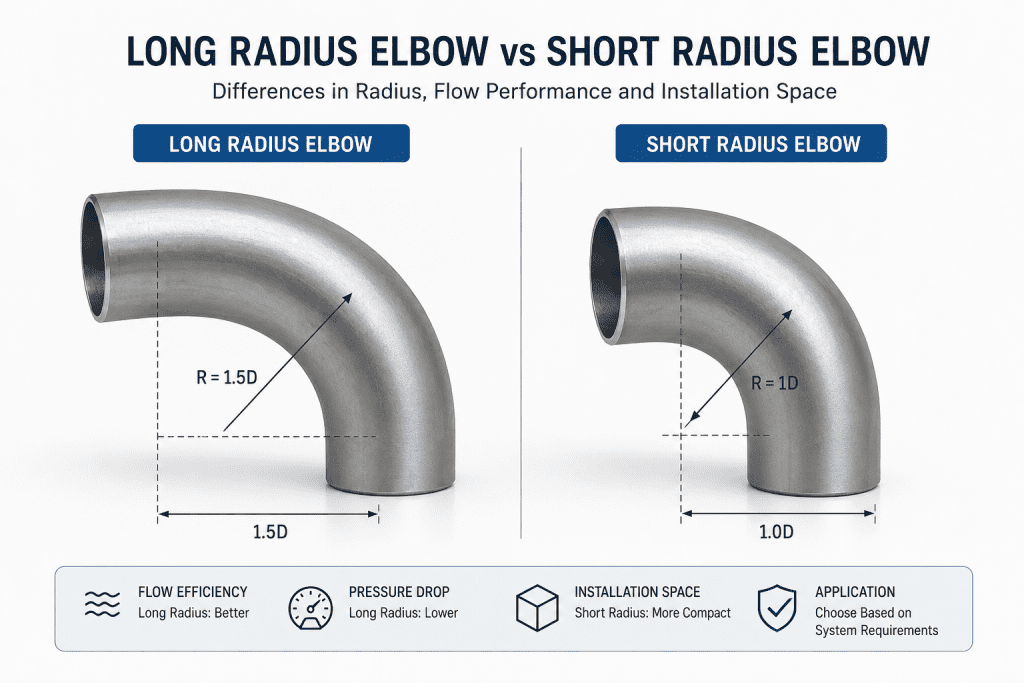
The primary distinction between these two types of butt weld fittings lies in the Center-to-End distance, which is directly proportional to the pipe’s nominal diameter (D).
1. Long Radius (LR) Elbows
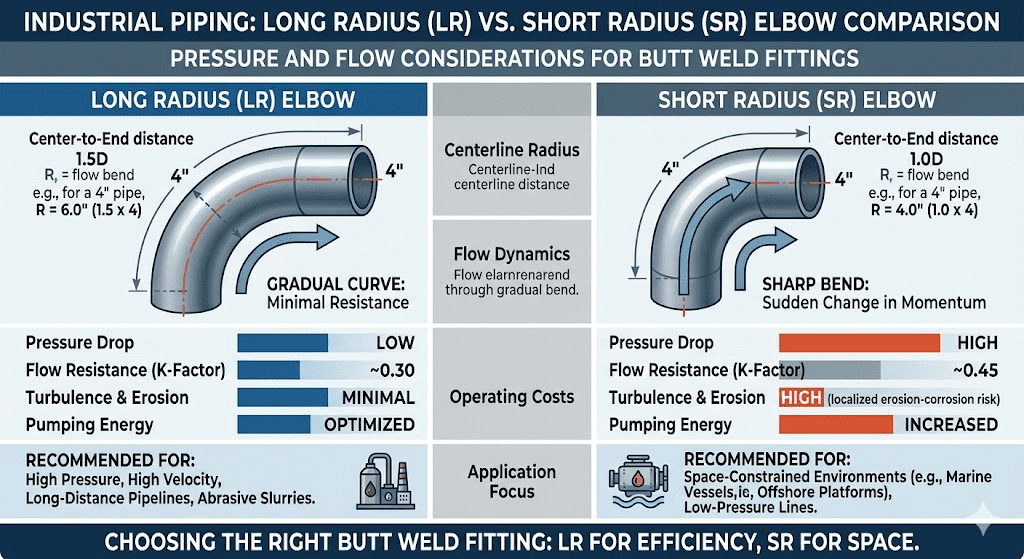
In a Long Radius elbow, the centerline radius (R) is equal to 1.5 times the nominal pipe size (D).
Formula:
R=1.5D
Characteristics: The curve is gradual and gentle. For example, on a 4-inch pipe, the radius of the bend will be 6 inches.
2. Short Radius (SR) Elbows
In a Short Radius elbow, the centerline radius (R) is exactly equal to the nominal pipe size (D).
Formula:
R=1.0D
Characteristics: The bend is sharp and compact. For a 4-inch pipe, the radius of the bend is 4 inches.
Flow and Pressure Considerations: The Core Engineering Metrics
When fluids or gases travel through a piping system, any change in direction creates resistance, leading to friction and pressure loss. The geometry of the elbow directly determines the severity of this resistance.
| Feature / Metric | Long Radius (LR) Elbow (R=1.5D) | Short Radius (SR) Elbow (R=1.0D) |
| Pressure Drop (ΔP) | Low. The gradual bend minimizes resistance. | High. The sharp turn forces a sudden change in momentum, increasing pressure drop. |
| Flow Resistance (K-Factor) | Lower resistance coefficient (K≈0.30 for 90∘). | Higher resistance coefficient (K≈0.45 for 90∘). |
| Fluid Turbulence & Erosion | Minimal turbulence; lower risk of localized erosion. | High turbulence; increased risk of erosion-corrosion, especially at high velocities. |
| Space Requirements | Requires more physical space for installation. | Exceptionally compact; ideal for tight, congested layouts. |
| Cost Efficiency | Typically standard pricing; widely stocked. | Sometimes slightly lower production cost, but can increase long-term operational costs due to pumping power loss. |
Pressure Drop and Pumping Costs
The sudden change in direction in an SR elbow causes a localized pressure drop (ΔP). In large-scale operations or long-distance piping networks, continuous pressure drops require pumps or compressors to work harder, significantly increasing energy consumption and operational expenditures (OPEX). LR elbows are universally preferred to conserve pumping energy.
Erosion and Wear
High-velocity fluids, slurry, or volatile fluids passing through a sharp SR bend create severe turbulence. The fluid impacts the outer wall of the elbow with high force, accelerating erosion-corrosion. LR elbows provide a smoother transition, extending the lifespan of the piping system.
Best Applications for Each Type
When to Choose a Long Radius (LR) Elbow
Long Radius elbows are the industry standard for the vast majority of processing plants. They are highly recommended for:
High-Pressure Systems: Where maintaining system pressure is vital.
High Flow Velocities: To mitigate turbulence and friction loss.
Abrasive Fluids & Slurries: Minimizes internal wear and extends the service life of the butt weld fittings.
Long-Distance Pipelines: Where cumulative pressure drops must be kept to an absolute minimum.
When to Choose a Short Radius (SR) Elbow
Short Radius elbows are specialized fittings utilized when geometry overrides fluid dynamics. They are best suited for:
Space-Constrained Environments: Such as marine vessels, offshore oil platforms, and compact chemical plant skids.
Low-Pressure Systems: Where minor pressure drops do not negatively affect system performance.
Low-Velocity Lines: Where the risk of turbulence and erosion is negligible.
Conclusion: Making the Right Engineering Decision
In the debate of Long Radius vs Short Radius Elbow, the decision hinges on balancing spatial limitations against hydraulic efficiency.
If your piping design has ample space and handles high-pressure, high-velocity, or erosive media, the Long Radius elbow is the optimal choice to ensure low pressure drops and maximum lifespan. Conversely, if you are designing a compact system where space is at a premium and flow velocities are low, the Short Radius elbow is your ideal solution.
As a leading supplier of high-quality butt weld fittings, we provide fully certified LR and SR elbows tailored to meet international standards (ASME, EN, DIN).
Need Technical Support or a Project Quote? Contact our engineering team today to find the perfect fittings for your specific industrial application.