Butt Weld vs Socket Weld Fittings: Advantages & Applications
Choosing the right piping components is a critical decision in industrial piping system design, directly impacting safety, structural integrity, and project budget. Two of the most widely used methods for connecting pipes and fittings are butt welding and socket welding.
While both methods provide robust, leak-proof connections, they differ significantly in their design, installation procedures, and ideal applications. This comprehensive guide compares butt weld fittings and socket weld fittings to help you make an informed choice for your next piping project.
What Are Butt Weld Fittings?
A butt weld fitting is designed to be welded on-site at its ends to connect pipes together and allow changes in direction or multi-port connections.
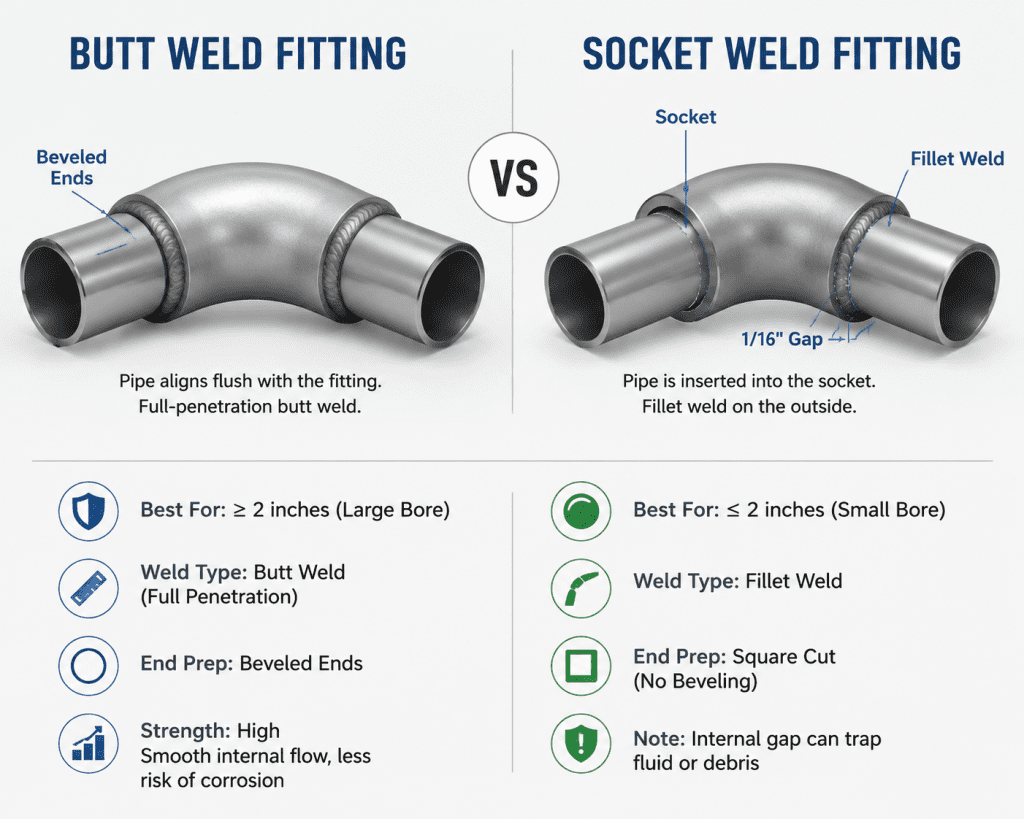
The ends of both the pipe and the fitting are typically beveled to create a valley for the weld bead. During installation, the fitting is aligned flush with the pipe end, and a full-penetration weld is applied around the circumference.
Key Characteristics
- Welding Method: Butt welding (typically TIG or MIG welding)
- End Preparation: Beveled ends according to ASME B16.9 or ASME B16.25
- Pipe Sizes: Commonly used for pipes 2 inches and larger, up to 72 inches and beyond
- Joint Strength: Full-penetration weld provides maximum structural integrity
What Are Socket Weld Fittings?
A socket weld fitting features a recessed area (socket) into which the pipe is inserted.
Unlike butt weld fittings, the pipe does not sit flush against the fitting edge. Instead, it slips into the socket before welding.
Before welding, a small expansion gap (typically 1/16 inch) is left between the pipe end and the socket shoulder to accommodate thermal expansion. A fillet weld is then applied around the outer circumference of the joint.
Key Characteristics
- Welding Method: Fillet welding
- Standard: ASME B16.11
- End Preparation: Plain-end pipe with square-cut ends
- Pipe Sizes: Primarily used for pipes 2 inches and smaller
- Installation: Faster and easier alignment compared to butt welding
Butt Weld vs Socket Weld: Head-to-Head Comparison
| Feature | Butt Weld Fittings | Socket Weld Fittings |
|---|---|---|
| Applicable Pipe Size | ≥ 2 inches (Large Bore) | ≤ 2 inches (Small Bore) |
| Joint Type | Full-Penetration Butt Weld | Fillet Weld |
| End Preparation | Beveled Ends Required | Plain Square-Cut Ends |
| Alignment | Requires Precise Fit-Up | Self-Aligning Design |
| Internal Flow | Smooth Bore, No Crevices | Internal Gap May Trap Debris |
| Stress Concentration | Low | Higher at Fillet Weld |
| Pressure Capability | High | Very High (Class 3000, 6000, 9000) |
| Installation Time | Longer | Faster |
| Maintenance Risk | Lower | Potential Crevice Corrosion |
Advantages and Disadvantages of Butt Weld Fittings
Advantages
Superior Strength
Full-penetration welds provide exceptional resistance to fatigue, vibration, pressure fluctuations, and high temperatures.
Smooth Internal Flow
The matching internal diameters create a smooth flow path, minimizing:
- Turbulence
- Erosion
- Pressure drop
- Localized corrosion
Long-Term Reliability
Butt weld joints offer excellent leak resistance and lower maintenance requirements throughout the service life of the pipeline.
Disadvantages
More Complex Installation
Proper alignment, fit-up, and welding procedures require skilled welders and specialized equipment.
Higher Labor Cost
Edge beveling and multiple weld passes increase installation time and labor expenses.
Advantages and Disadvantages of Socket Weld Fittings
Advantages
Easy Alignment
The socket design automatically positions the pipe, reducing alignment difficulties during installation.
No Beveling Required
Square-cut pipe ends eliminate the need for edge preparation, saving fabrication time.
Cost-Effective for Small Lines
Socket weld fittings are often the most economical choice for small-bore piping systems because of reduced labor and installation costs.
Disadvantages
Expansion Gap Sensitivity
Failure to maintain the required 1/16-inch expansion gap can result in thermal stress and weld cracking.
Crevice Corrosion Risk
The internal pocket between the pipe end and socket shoulder can collect:
- Moisture
- Corrosive fluids
- Sediment
- Process contaminants
This may lead to:
- Crevice corrosion
- Stress corrosion cracking (SCC)
- Premature joint failure
Unsuitable for Hygienic Applications
The hidden internal gap makes cleaning and sterilization difficult, limiting use in food, beverage, and pharmaceutical systems.
Ideal Application Scenarios
When to Choose Butt Weld Fittings
Butt weld fittings are recommended for:
High-Pressure and High-Temperature Systems
- Power plant steam lines
- Chemical reactors
- Refinery process piping
Corrosive or Hazardous Media
- Chemical processing plants
- Petrochemical facilities
- Offshore platforms
Large-Diameter Pipelines
- Oil transmission pipelines
- Natural gas pipelines
- Municipal water infrastructure
Critical Structural Applications
- Systems exposed to vibration
- Cyclic loading conditions
- High mechanical stress environments
When to Choose Socket Weld Fittings
Socket weld fittings are ideal for:
Small-Bore Piping Networks
- Instrument tubing systems
- Hydraulic lines
- Control valve bypass piping
Non-Corrosive Services
- Compressed air systems
- Utility water lines
- Lubrication systems
Limited Installation Space
Facilities where welding access and pipe alignment are restricted.
Cost-Sensitive Projects
Projects requiring quick installation and reduced labor costs.
Industry Standards and Codes
The most commonly referenced standards include:
- ASME B16.9 – Factory-Made Wrought Butt Welding Fittings
- ASME B16.11 – Forged Socket Weld and Threaded Fittings
- ASME B16.25 – Butt Welding Ends
- ASME B31.3 – Process Piping Design Code
Compliance with these standards ensures safety, reliability, and regulatory acceptance.
Conclusion: Which One Is Right for Your Pipeline?
The choice between butt weld fittings and socket weld fittings depends on your piping system’s size, operating conditions, budget, and maintenance requirements.
Choose Butt Weld Fittings if you need:
- Large-diameter piping
- High-pressure service
- High-temperature applications
- Corrosive media handling
- Maximum long-term reliability
Choose Socket Weld Fittings if you need:
- Small-bore piping systems
- Faster installation
- Lower fabrication costs
- Compact piping layouts
- Moderate service conditions
By selecting the appropriate fitting type and following industry standards such as ASME B31.3, engineers can ensure safe, efficient, and long-lasting piping system performance.