
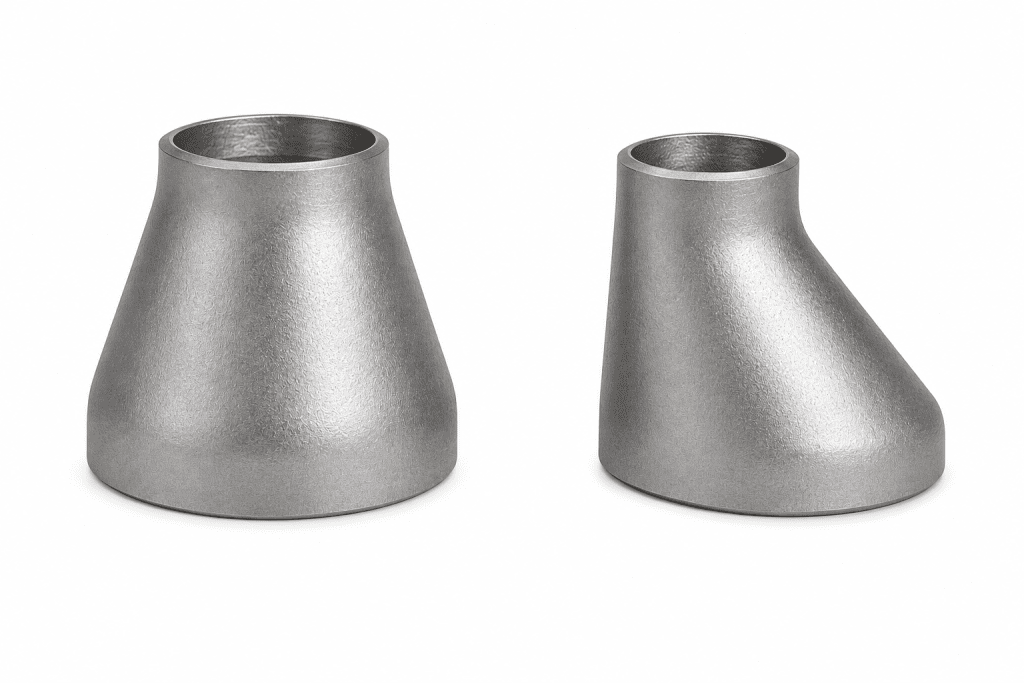
Concentric vs Eccentric Reducers: Pipeline Flow Solutions
Introduction
Reducers are essential components in industrial piping systems, designed to connect pipes of different diameters while maintaining smooth fluid transportation. In industries such as oil & gas, chemical processing, water treatment, HVAC, and power generation, selecting the correct reducer type directly affects system efficiency, pressure stability, and equipment safety.
The two most common reducer types are concentric reducers and eccentric reducers. Although both serve the same purpose of changing pipe diameter, their structural differences determine how fluids flow through the pipeline.
Understanding when to use a concentric reducer versus an eccentric reducer helps engineers minimize turbulence, prevent cavitation, reduce vibration, and improve overall pipeline performance.
What Is a Concentric Reducer?
A concentric reducer is a pipe fitting where the centerlines of both the larger and smaller pipes remain aligned. The reducer has a symmetrical cone shape, creating a smooth and balanced transition between pipe sizes.
Main Features of Concentric Reducers
- Symmetrical design
- Centerline alignment
- Uniform flow distribution
- Smooth pressure transition
- Easy installation in vertical piping systems
Common Applications
Concentric reducers are widely used in:
- Vertical liquid pipelines
- Gas and steam pipelines
- Process piping systems
- High-pressure industrial systems
- Chemical and refinery applications
Because the pipe centerline remains consistent, concentric reducers are ideal for applications where balanced flow and pressure stability are critical.
What Is an Eccentric Reducer?
An eccentric reducer has one side flat, meaning the centerlines of the connected pipes are offset. This design prevents the accumulation of air, gas, or liquid inside the piping system.
Main Features of Eccentric Reducers
- Offset centerline design
- Flat top or flat bottom installation
- Reduced risk of air pockets
- Improved pump suction performance
- Better drainage capability
Common Applications
Eccentric reducers are commonly used in:
- Horizontal liquid pipelines
- Pump inlet piping
- Slurry transportation systems
- Drainage pipelines
- Oil and wastewater systems
The offset design makes eccentric reducers especially important in systems where trapped air or liquid buildup could damage pumps or interrupt flow.
Key Differences Between Concentric and Eccentric Reducers
1. Structural Design
A concentric reducer maintains a common centerline, while an eccentric reducer offsets one side of the fitting.
- Concentric reducer: symmetrical cone
- Eccentric reducer: flat-sided transition
This structural difference directly affects pipeline flow behavior.
2. Flow Characteristics
Concentric Reducer Flow
Concentric reducers provide uniform flow distribution, making them suitable for gases, steam, and vertical fluid movement.
Advantages include:
- Stable pressure transition
- Reduced turbulence
- Balanced velocity changes
Eccentric Reducer Flow
Eccentric reducers help avoid air pockets in horizontal pipelines.
Advantages include:
- Improved pump efficiency
- Prevention of cavitation
- Better drainage performance
How to Choose Between Concentric and Eccentric Reducers
Selecting the correct reducer depends on several engineering factors.
Use a Concentric Reducer When:
- The pipeline is vertical
- The system transports gas or steam
- Balanced flow is required
- Centerline alignment is important
- Pressure distribution must remain uniform
Use an Eccentric Reducer When:
- The pipeline is horizontal
- The system handles liquids or slurry
- Pump suction piping is involved
- Air accumulation must be prevented
- Drainage efficiency is critical
Why Eccentric Reducers Are Important for Pump Systems
In pump suction lines, trapped air can cause cavitation, vibration, noise, and severe equipment damage. An eccentric reducer installed with the flat side on top prevents air pockets from forming.
This design helps:
- Maintain stable liquid flow
- Protect pump impellers
- Reduce maintenance costs
- Extend equipment service life
For horizontal suction piping, eccentric reducers are considered an industry-standard solution.
Materials Used for Pipeline Reducers
Industrial reducers are manufactured in various materials depending on operating conditions and media compatibility.
Common Materials
Carbon Steel Reducers
Suitable for:
- Oil & gas pipelines
- High-pressure systems
- Industrial process piping
Stainless Steel Reducers
Suitable for:
- Corrosive environments
- Food processing
- Pharmaceutical systems
- Chemical plants
Alloy Steel Reducers
Suitable for:
- High-temperature applications
- Power plants
- Refinery systems
Duplex Stainless Steel Reducers
Suitable for:
- Offshore pipelines
- Marine environments
- Chloride-rich systems
Manufacturing Standards for Reducers
High-quality pipeline fittings are manufactured according to international standards to ensure dimensional accuracy and pressure integrity.
Common Standards
- ASME B16.9
- ASTM A234
- ASTM A403
- MSS SP-75
- DIN pipe fitting standards
- EN pipeline fitting standards
These standards define dimensions, tolerances, wall thickness, and material requirements for industrial piping systems.
Welding and Installation Considerations
Proper installation is essential for pipeline performance.
Installation Tips for Concentric Reducers
- Maintain centerline alignment
- Use proper welding procedures
- Verify pressure ratings
- Ensure smooth internal transitions
Installation Tips for Eccentric Reducers
- Install flat side up on pump suction lines
- Avoid improper orientation
- Check flow direction carefully
- Minimize turbulence near pumps
Correct orientation significantly improves system reliability and operational efficiency.
Concentric vs Eccentric Reducer: Which Is Better?
Neither reducer is universally better. The correct choice depends entirely on the pipeline design and fluid transport requirements.
| Application | Recommended Reducer |
| Vertical pipelines | Concentric reducer |
| Gas or steam systems | Concentric reducer |
| Horizontal liquid pipelines | Eccentric reducer |
| Pump suction lines | Eccentric reducer |
| Slurry systems | Eccentric reducer |
| Drainage systems | Eccentric reducer |
Engineering evaluation of fluid behavior, pipe orientation, and equipment protection is essential before selection.
Conclusion
Both concentric reducers and eccentric reducers play critical roles in modern industrial piping systems. Choosing the appropriate reducer improves flow stability, protects equipment, reduces operational risks, and enhances overall pipeline efficiency.
Concentric reducers are ideal for balanced flow and vertical applications, while eccentric reducers are essential for horizontal liquid transport and pump protection.
For industrial pipeline projects involving oil & gas, chemical processing, water treatment, LNG systems, or power generation, selecting the right pipeline fittings ensures long-term operational reliability and safety.
High-quality reducers manufactured according to international standards provide superior sealing performance, structural strength, and corrosion resistance for demanding industrial environments.